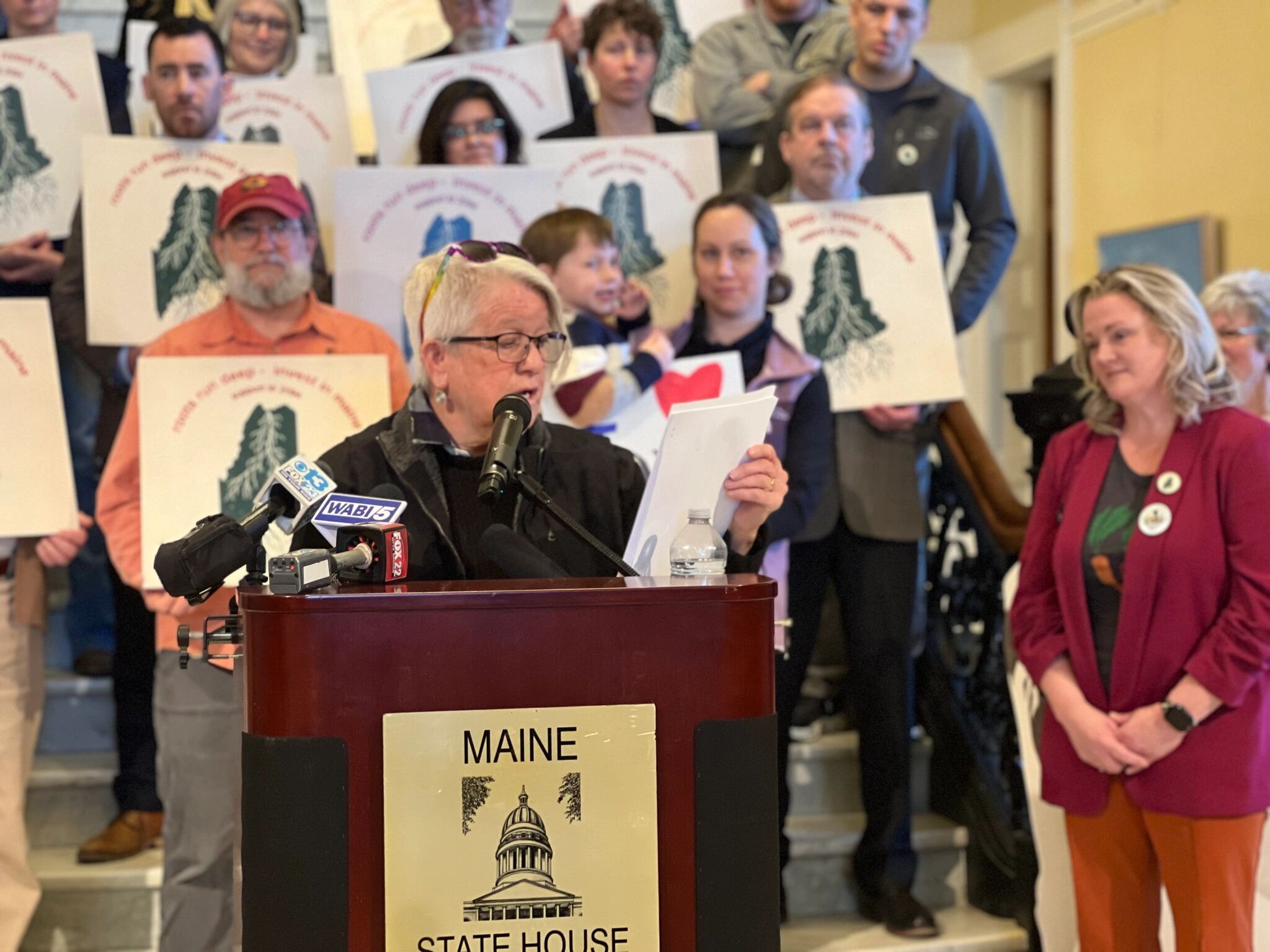
I have lived in Maine my whole life, and these days I live just down the street from the State House. Still, every time I walk through those doors, I feel a small rush of excitement. So, after dropping the kids off at school, I hastily gathered my promotional materials, loaded up a large white poster board, and made my way over for Maine Ag Day at the Legislature.
Maine Ag Day is one of those events that brings together the many pieces of Maine agriculture in one place. Farmers, producers, service providers, nonprofits, educators, agency staff, legislators, and members of the public all pass through the Hall of Flags. This year’s event also coincided with broader Agriculture Week activities and the state’s recognition of the Year of the Woman Farmer, highlighting the leadership of women across Maine’s farms and food system.
There was also a strong youth and education presence. The Maine Department of Agriculture, Conservation and Forestry organized a Youth Agriculture Policy Day in partnership with the Maine Department of Education, Maine FFA, and University of Maine Cooperative Extension 4-H. Students had the opportunity to tour the Capitol, meet with legislators and agricultural leaders, and observe the work of the Legislature’s Agriculture, Conservation and Forestry Committee.
That setting made it a good place to ask a simple question:
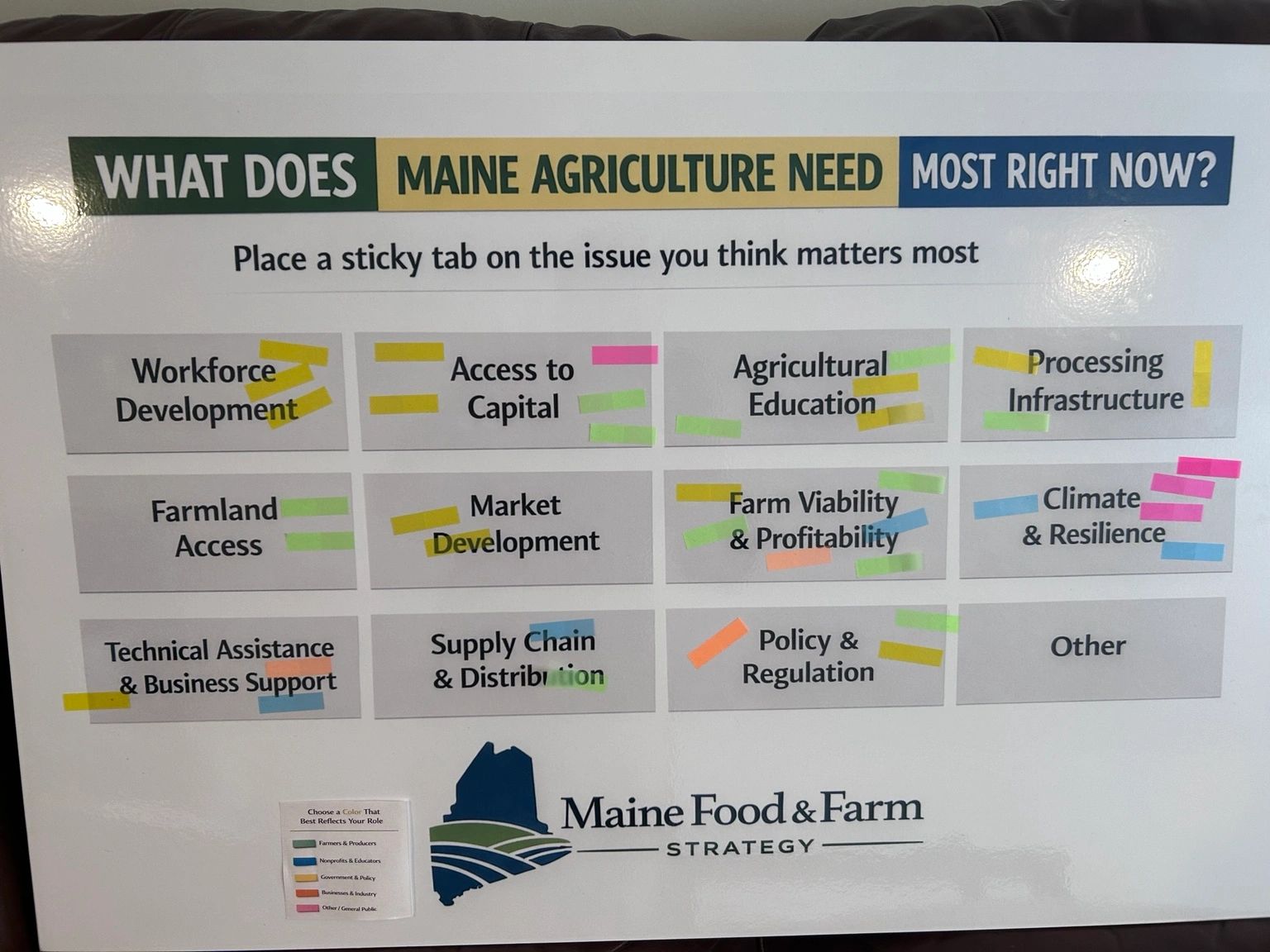
What does Maine agriculture need most right now?
Admittedly, my method was not especially polished or even remotely scientific. I had a large white poster board, a set of issue areas, and colored sticky tabs. When it was conversationally appropriate, I asked people who stopped by the table to choose the issue they thought mattered most and place a tab on the board. The colors corresponded to different roles: farmers and producers, nonprofits and educators, government and policy, businesses and industry, and members of the general public.
It was a little awkward. People had to pause, read the options, decide where they fit, and then physically stick a tab on the board. But that was also the point. It created a small moment of reflection and often led to a short conversation.
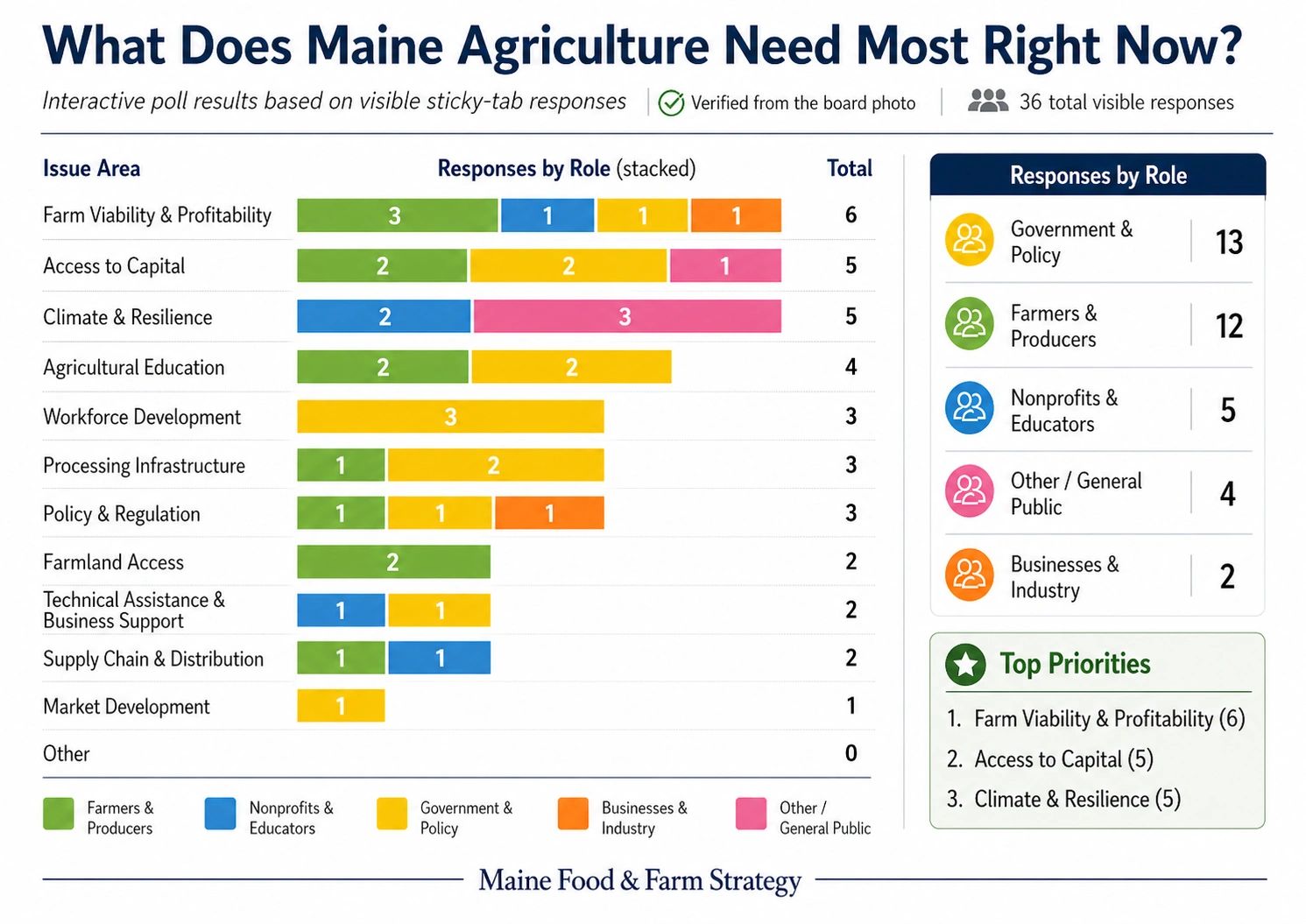
By the end of the day, the responses clustered around three priorities: farm viability and profitability, access to capital, and climate and resilience.
That felt significant, especially given the setting. Maine Ag Day is not a formal research environment. It is busy, public, and conversational. Farmers, agency staff, legislators, nonprofits, educators, students, businesses, and members of the public are all moving through the Hall of Flags. So I don’t want to overstate the results. This was an informal listening exercise, not a scientific survey.
Still, the pattern was useful.
The top response, farm viability and profitability, is the issue beneath almost every other issue. Land access, labor, equipment, processing, regulation, marketing, education, and climate adaptation all matter because they shape whether farms can actually survive and make a living.
Access to capital points in the same direction. Many farms and food businesses are not short on ideas. They are short on workable ways to finance them — whether that means land, equipment, storage, processing capacity, staffing, or the cash flow needed to make use of grant and loan programs.
And climate and resilience suggests that people are thinking not only about today’s farm economy, but also about the instability ahead. Heavy rain, drought, shifting seasons, soil health concerns, pests, and market volatility are already shaping farm decisions. Resilience is important, but it also costs money.
What stood out to me is how connected these priorities are. A farm cannot invest in resilience without capital. Workforce development matters most when farms are viable enough to hire and retain people. Agricultural education is stronger when it connects to real opportunities in farming and food businesses.
So while the poll was simple, the results pointed to something bigger: Maine agriculture needs coordinated, practical support systems that help farms stay viable, access resources, and adapt to changing conditions.
And on that day, with a large white poster board and a pile of sticky tabs, that message came through clearly.