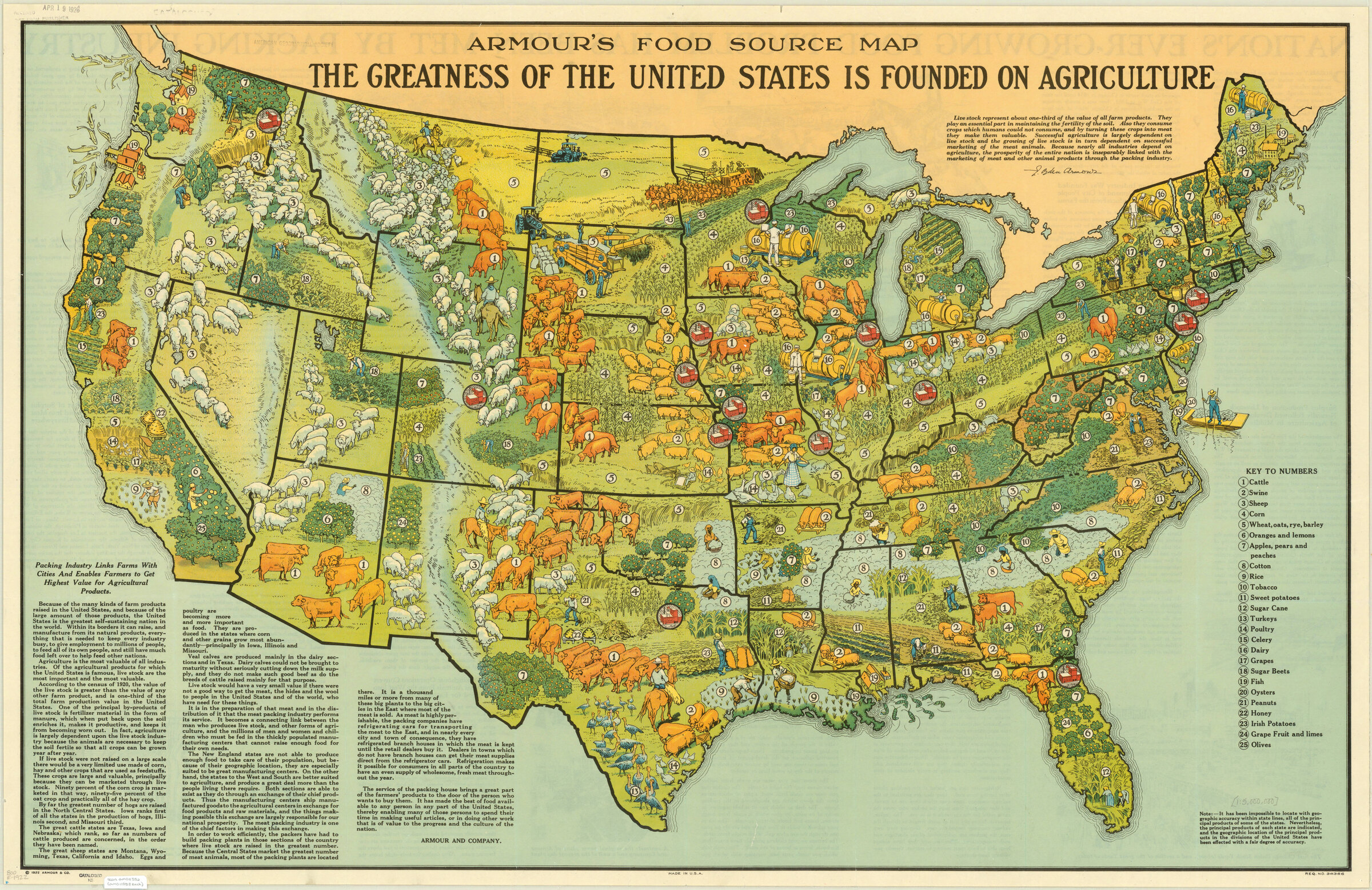
The 1922 Armour’s Food Source Map is a useful reminder that the national food system did not emerge by accident. It was built through rail, refrigeration, processing, and large-scale distribution. That system produced real benefits: larger markets for producers, more consistent supplies for consumers, and a level of scale that helped make food more widely available across the country. That is the historical achievement. The strategic problem is that the same system also created very deep dependence on transportation and fuel.
Today, that dependence is hard to ignore. Trucks move the majority of U.S. freight tonnage. When diesel rises, the effect does not stay at the truck stop. It moves through food distribution, warehousing, and farm logistics. In September 2026, the U.S. weekly average for on-highway ultra-low-sulfur diesel reached $6.285 per gallon, according to the U.S. Energy Information Administration.
Fuel matters on the farm as well as on the road. Modern agricultural productivity rests heavily on mechanization: tractors, harvest equipment, irrigation, hauling, drying, and other fuel-dependent operations. USDA’s Economic Research Service reports that higher spending on fuel and oils is among the major drivers of rising farm production expenses in 2026. Diesel is not just a transportation cost. It is embedded in the production system itself.
That does not mean the answer is to abandon the national food system. It means building more resilience into it. One practical response is to strengthen local and regional food systems so that more food can be aggregated, processed, stored, and sold closer to where people live.
Part of that resilience is also cultural. Maine cannot produce everything its residents eat, nor should it try. But a stronger regional food system becomes more viable when consumers are willing to eat more of what the region already produces well. For Mainers, that could mean a somewhat greater place in the diet for seafood, potatoes, blueberries, dairy, grains, and other products already rooted in Maine’s agricultural and fisheries economy. That would not eliminate dependence on national and international markets, but it could reduce some of that dependence while creating more stable demand for local producers.
For Maine, that suggests a practical strategy: more regional processing capacity, more cold storage, more grain and value-added infrastructure, more food hubs, stronger institutional procurement links between Maine producers and Maine buyers, and a food culture that makes greater use of what Maine already produces.
A food system that depends heavily on diesel is vulnerable when diesel spikes. A state with more regional capacity — and more regional demand — is better positioned to absorb that shock.
Sources
- U.S. Energy Information Administration — Weekly U.S. diesel retail prices
- U.S. Department of Transportation, Bureau of Transportation Statistics — Freight Shipments by Mode
- USDA Economic Research Service — Farm Sector Income Forecast
- USDA Economic Research Service — Local Food Systems: Concepts, Impacts, and Issues
- Maine DACF — Resilient Food Systems Infrastructure Program